Chaos into Order (LEC)
A physics-informed network that learns the expected solution of a stochastic PDE directly, from sampled noise and the equation alone, with no pathwise solves, no discretization grid and no solution data.
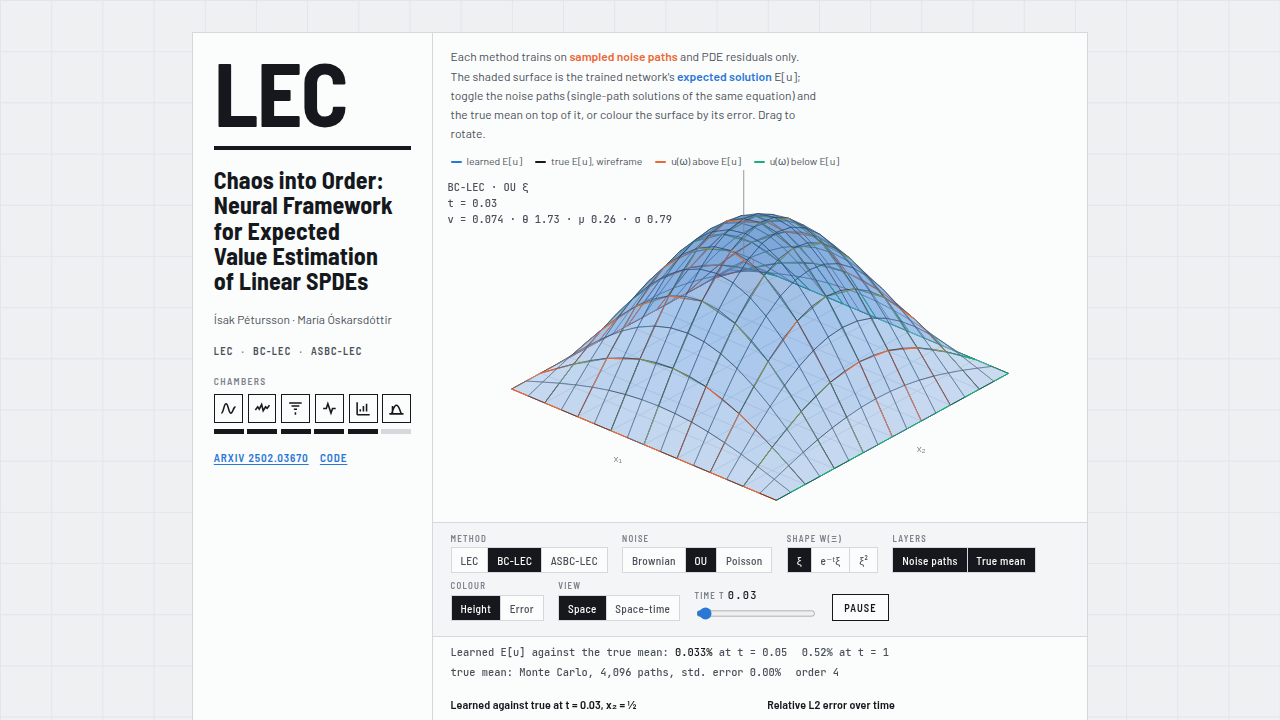
The learned mean of a 2-D stochastic heat equation with Ornstein–Uhlenbeck noise, against the true mean (0.03% error at t = 0.05). In the explorer you can rotate it, switch method and noise, and overlay single noise paths.
The problem
Stochastic PDEs describe fields driven by noise: heat in a randomly forced medium, prices under random volatility, populations in a random environment. Often what's needed is the average behaviour, the expected solution E[u]. The standard route is Monte Carlo: solve the equation thousands of times, once per noise path, on a grid, and average. That gets expensive fast, especially as the dimension grows.
The idea: average the residual, then square it
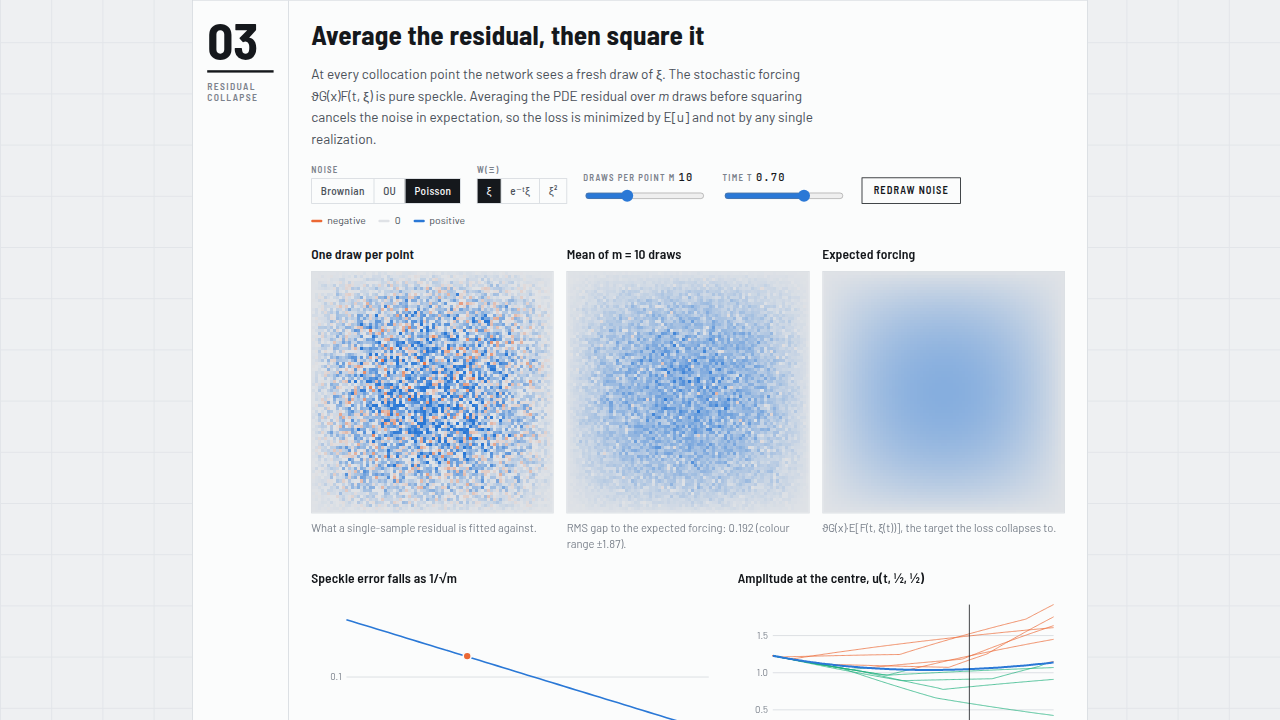
LEC (Learned Expectation Collapser) trains one network on the PDE residual, but at every collocation point it averages the residual over a few fresh noise draws before squaring. The noise cancels in expectation, so the loss is minimized by E[u] itself rather than by any single noisy realization. Noise parameters are network inputs, so one trained model covers a whole family of noise processes.
The extension: when the noise multiplies the solution
The original collapse needs the noise to enter additively. When it multiplies a coefficient of the equation, the noise and the solution become entangled, and the unmodified method converges to the wrong answer. The extension adds two methods:
- BC-LEC, for noise in a lower-order term: expands the solution as a Dyson series around the noise-free equation and collapses each order in turn, with the order chosen adaptively.
- ASBC-LEC, for noise in the principal part (the diffusion itself): expands around a re-centred reference coefficient chosen per draw.
Both come with an error estimate computed from training quantities only. It certifies a solution when the estimate is small and flags the cases it cannot trust, so failures are visible without knowing the answer.
Results
PreliminaryWork in progress and subject to change: the extension is in preparation, and the higher-dimensional runs are still going.
Median relative L2 error against a reference mean, over 128 random draws of the noise parameters per cell. Three noise processes (Brownian motion with drift, Ornstein–Uhlenbeck, compound Poisson), each in three shapes, nine drivers in all.
| Driver (d = 2, three seeds) | Noise-free baseline | Unmodified LEC | BC-LEC |
|---|---|---|---|
| Ornstein–Uhlenbeck | 4.01% | 71% | 0.30% |
| Telegraph | 3.90% | 61% | 0.24% |
| Shot noise | 0.38% | 11% | 0.12% |
Where it stops
Noise in the diffusion term with heavy tails is the hard case: with compound Poisson noise ASBC-LEC reaches 4–5%, and with its squared form it fails (31–38%). Some configurations have no finite mean at all. In each of these the method flags the result rather than reporting a confident wrong answer. Higher-dimensional runs (d = 8) are still in progress.